
Holding a ceremony to commemorate the national registration of Teng and signing a memorandum of understanding between the University of Zabol and the General Administration of Cultural Heritage
According to the Public Relations Department of Zabol University:
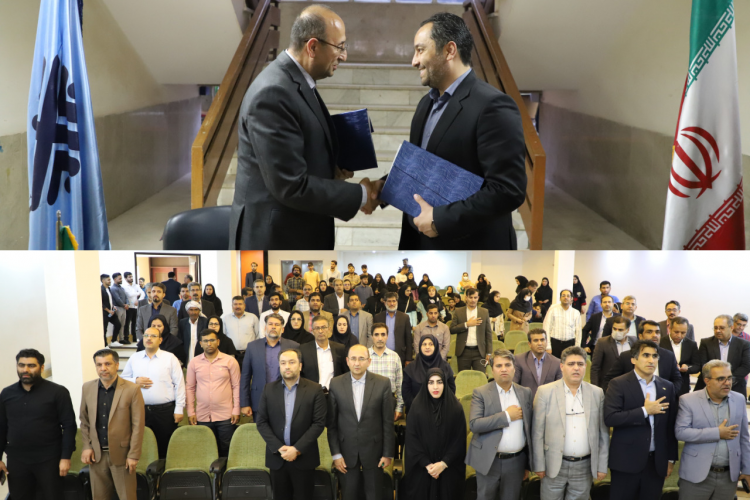
With the support of the Faculty of Arts and Architecture, the ceremony of “Celebrating the National Registration of Teng, Indigenous Knowledge of Climate Resilience in Coexistence with Wind and Managing Quicksand in the Sistan Plain” was held at the amphitheater of the Faculty of Agriculture with the presence of Dr. Afrasiab; the Honorable President of the University, Dr. Tehrani Moghadam; the Honorable Director General of Cultural Heritage, Tourism and Handicrafts of the Province, Dr. Sarwarinejad; the Honorable Deputy of the General Directorate of Natural Resources and Watershed Management of the Province, Engineer Moein Afshar; the Honorable Deputy for Civil Engineering of the Zabol Special Governorate and a group of Deputy Governors, District Governors, Honorable Officials of Executive Bodies and the Academic Community from the provincial center and the five cities of Sistan.
In this ceremony, parts of which were broadcast live on the Khabar network, Dr. Afrasiab, the university president, considered one of the main goals of holding these commemorations to familiarize the future generation, especially students, with the culture and civilization and the rich content that lies behind them, and added: Today is a great day and we are proudly in a place to take out a golden leaf from the heart of our history and to register another historical work and tradition of this land and region in the national register.
He added: These are cultural indicators that create an identity for a nation. The Teng phenomenon is a unique element that has its roots in the thousands of years of science of this land and region and shows the type of human interaction with the environment and how to deal with natural crises. This honor belongs to all those who are the heirs of the science and art of this region and extracted this historical phenomenon from books and historical documents and, by finding its last remains in the region, began to document and conduct scientific and research work.
In this ceremony, Dr. Heydari, Dean of the Faculty of Art and Architecture of Zabol University, while extending his greetings and congratulating the Cultural Heritage Week, pointed out the close and constant interaction of the Faculty of Art and Architecture with the Cultural Heritage Department and added: The type of interaction of the people of Sistan region in ancient times was very intelligent; so that to deflect the wind before reaching the settlement, they used the method of creating a teng and to use the wind inside the settlement, they used special Sistani roofs as well as kolak and kharkhaneh. At the end of his speech, he announced the full readiness of Zabol University and especially the Faculty of Art and Architecture to cooperate in the national registration of these elements.
Dr. Tehrani Moghadam, Director General of Cultural Heritage, Tourism and Handicrafts of the province, while commemorating the International Museum Day and Cultural Heritage Week, said: Teng is an intangible heritage and a cultural asset. He considered the most important cultural assets to be intangible heritages such as rituals, customs, traditions, building skills, production skills, and indigenous and local knowledge such as the Teng phenomenon, which has reached the national registration stage thanks to the efforts of researchers at Zabol University and the cooperation of the General Directorate of Cultural Heritage. He added: We must accept that modern science cannot respond to issues related to climate crises without indigenous knowledge, and by preserving these two knowledges together, we can take steps towards development.
At the end of his speech, the Director General of Cultural Heritage noted that one of the main tasks of the Cultural Heritage Department is to ensure that no work or knowledge is destroyed, and we will do our best to record, preserve, revive, and perpetuate that work.
At the end of this ceremony, on the occasion of Cultural Heritage Week, the respected members of the faculty of the Department of Archaeology at Zabol University; Teng-making masters, as well as Dr. Ali Shahriari, Engineer Mohammad Reza Jirga, and Mr. Reza Barani and Ahmad Barani, were honored for their scientific, research, and executive activities regarding Teng and the national registration of this ancient Sistani method.
On the sidelines of this ceremony, a memorandum of understanding was signed between the University of Zabol and the General Directorate of Cultural Heritage, Tourism, and Handicrafts of Sistan and Baluchestan in the fields of science and research.
It should be noted that Teng is an ancient and indigenous method of Sistan for reducing the mobility of quicksand, which the people of the region use to reduce the effects of sandstorms. The intertwined branches of Gaz, which, when placed in a specific way, keep moving sand away from cities and prevent settlements and agricultural lands from being buried.
Your Comment :