
An article written by researchers from the Chemistry Department of the Faculty of Science, University of Zabol, was published in the prestigious journal Chemical Society Reviews.
According to the Public Relations Department of Zabol University:
The article written by researchers from the Chemistry Department of Zabol University entitled:
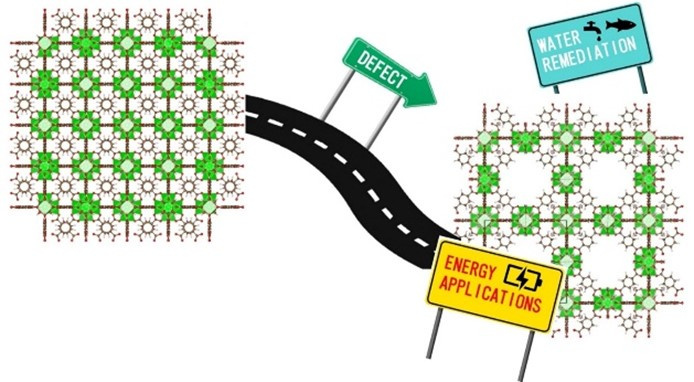
Defect-enabling zirconium-based metal–organic frameworks for energy and environmental remediation applications
was published in the prestigious journal Chemical Society Reviews with an impact factor of about 46, published by the Royal Society of Chemistry.
Generally, "defect" means incompleteness. Although it may not be popular in human life, it is interesting to know that researchers from various fields are actively and day and night trying to intentionally create and study defects in materials and their applications. Instead of trying to achieve a perfect and flawless structure, scientists are looking to take advantage of the unique properties and capabilities resulting from these structural defects, and research has shown that the presence of defects in structures can lead to the emergence and presentation of remarkable properties and capabilities that are impossible to achieve in perfect structures.
This article shows the promising prospects of zirconium-based defect-free metal-organic frameworks (MOFs) in solving challenging energy and environmental problems, and introduces them as valuable materials for achieving a cleaner and greener future.
It is worth noting that metal-organic frameworks are a new class of porous nanomaterials that have great diversity and efficiency in various fields.
This article was published by Dr. Alireza Oveisi (Associate Professor of Organic Chemistry at the University), Dr. Mostafa Khajeh (Professor of Analytical Chemistry at the University), Dr. Saba Daliran (Associate Professor of Organic Chemistry at the University of Lorestan) and in collaboration with researchers from universities in the United States, Spain, Taiwan, Turkey and India in support of scientific diplomacy and authority.
Free and open access link to the article (with permission from the journal):
https://pubs.rsc.org/en/Content/ArticleLanding/2024/CS/D3CS01057K
Your Comment :