
An archaeological project was carried out by the University of Zabol to determine the area and propose the boundaries of the Yangeh Qale hills of Bojnourd.
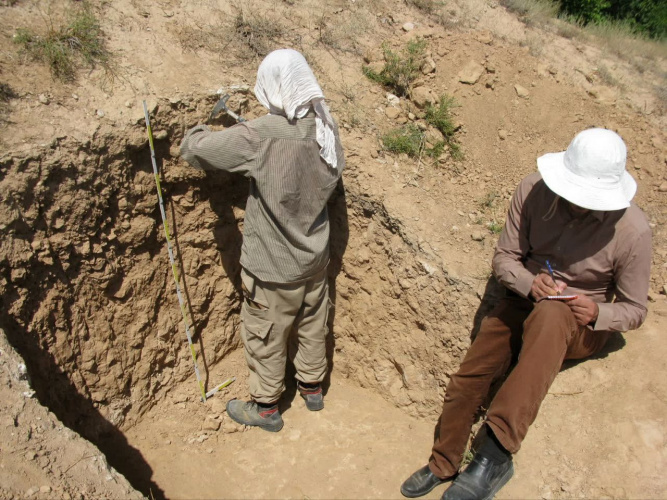
The field study program to determine the area and proposed boundary of the Yangeh Qale Hills was carried out with the financial support of the General Department of Cultural Heritage, Tourism and Handicrafts of North Khorasan Province and with the permission of the National Cultural Heritage and Tourism Research Institute under the supervision of Reza Naseri, a member of the faculty of the Department of Archaeology, Faculty of Art and Architecture, Zabol University, as an external project.
The Yangeh Qale Hills consist of two short and large elevations known as Yangeh Qale 1 and 2, which, according to available documents, contain evidence from the first millennium BC. Cultural materials of the Dehestan type and a type of engraved pottery dating back to the first millennium BC are found on the surface of both sites. The Dehestan culture flourished in the Iron Age in northeastern Iran in a wide area from the eastern shores of the Caspian Sea to the western regions of North Khorasan, and its livelihood was based on agriculture and animal husbandry.
In this field program, 20 test boreholes were opened in different parts of the Yangeh Qale hills, which showed that this monument was formed on natural protrusions on the edge of the Bojnourd plain and probably belonged to nomadic groups with temporary settlements.
Yangeh Qale hills have been exposed to destruction due to shallow plowing of the land in the past decades and due to their location within the city of Bojnourd, and unauthorized excavations have also caused damage to them. The main goal of the field program is to determine the extent and extent of the spread of archaeological remains in the Yangeh Qale hills, which will help develop a conservation plan and prepare a research strategy for the future of the monument. Yangeh Qale hills were registered in the list of national monuments of the country in 2007 with numbers 21224 and 21106.
Dr. Abolfazl Heydari, Dean of the Faculty of Art and Architecture of the University of Zabol, noted that this faculty has always been diligent in the field of preserving and promoting cultural heritage, especially archaeology of the region and the country, and has taken many measures. In the future, we hope that by activating the Archaeological Center of the Faculty of Art and Architecture, we will witness a greater role in the field of cultural heritage and archaeology at the regional, national and international levels. Dr. Majid Erfanian, Vice President for Research and Technology at Zabol University, added: Creating a research field by cooperating with other departments and organizations of the country through extracurricular projects and supporting researchers has been one of the goals of this vice president, and in the field of archaeological studies, Zabol University, as one of the most successful universities in cooperating with the country's cultural heritage departments, has taken many steps. He added that determining the area and proposing the boundary of the Yangeh Qale hills of Bojnourd was carried out with multiple research goals.
Your Comment :