
Publication of an article by members of the scientific associates of the Biotechnology Research Institute of Zabol University in the prestigious journal Scientific Reports, part of the Nature Subgroup Publications Collection
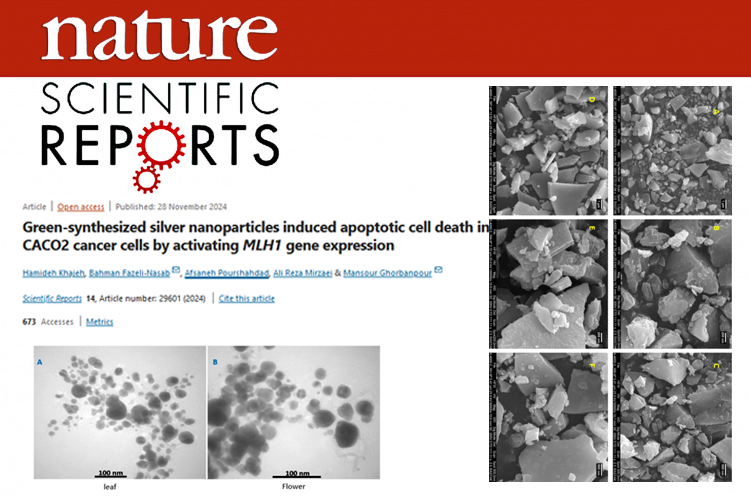
According to the university's public relations report, Ms. Hamideh Khajeh, an expert at the university's Biotechnology Research Institute, in collaboration with researchers from Zabol Research Institute, Arak University, University of Medical Sciences, and Ardebil University, has published an article titled "Green-synthesized silver nanoparticles induced apoptotic cell death in CACO2 cancer cells by activating MLH1 gene expression" in the prestigious journal Scientific Reports, a sub-group of Nature publications. In this study, researchers investigated the apoptotic properties of green-synthesized silver nanoparticles from the leaves and flowers of Moringa olifera on MLH1 gene expression and MTT cell test against colorectal cancer cell lines. Considering that colon cancer is the third most common type of cancer in terms of incidence and the third most common type of cancer in terms of mortality worldwide. In this regard, the present study aimed to investigate the effect of biological silver nanoparticles with anticancer properties and MLH1 gene expression on cancer cell samples of people with colon cancer. The results of this study showed that silver nanoparticles synthesized by Moringa oleifera can improve MLH1 gene expression and DNA repair. As a result, the apoptosis rate and anticancer properties in cells are increased. Both leaf and flower extracts of Moringa oleifera can effectively synthesize silver nanoparticles; however, leaf extract usually produces smaller and more uniform particles than flower extract. This difference is mainly attributed to the differences in phytochemical composition and their roles in the reduction and stabilization processes during nanoparticle formation.
Access link to the first article: https://www.nature.com/articles/s41598-024-80809-0
Your Comment :