
Publication of an article on the study of dengue fever virus transmission by a faculty member of the University of Zabol in the prestigious journal Scientific Reports
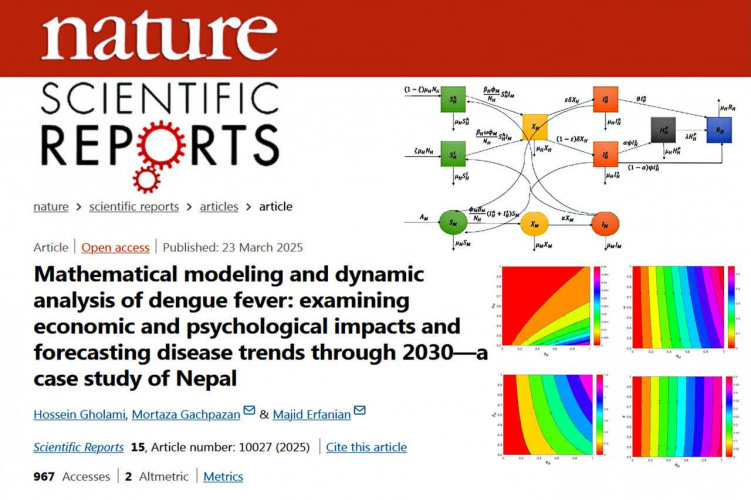
This study is based on presenting a mathematical model to investigate the dynamics of dengue fever virus transmission and provide solutions to contain and prevent its spread to other parts of the world.
Dengue fever is a viral disease that is mainly prevalent in tropical and subtropical regions and is transmitted through the bite of infected Aedes mosquitoes. Its mild form is characterized by fever and flu-like symptoms, and its severe form leads to severe bleeding, hypotension, and even death.
This model is adjusted using data related to dengue fever cases in Nepal during the year 2022 and the time period 2004 to 2022 and the least squares method. The results of the sensitivity analysis show that the recovery rate of infected individuals without symptoms and the natural mortality rate of mosquitoes have a negative effect on the basic reproductive number, while the mosquito bite rate, their reproduction rate and the probability of virus transmission from infected mosquitoes to humans have a positive effect on this indicator. Also, predictions made using the model show that by 2030, despite the fact that the population of infected mosquitoes is expected to increase, the number of patients hospitalized in hospitals will decrease. In addition, this study also examined the economic and psychological impacts of dengue fever on hospitalized patients. The findings of this study can be used to develop effective control strategies and improve public health policies to combat the spread of dengue fever.
This research was conducted jointly by professors from Ferdowsi University of Mashhad and Zabol University in the form of a doctoral thesis by Mr. Hossein Gholami under the joint supervision of Dr. Morteza Gachpazan and Dr. Majid Erfanian.
To access the article, use the following link:
https://www.nature.com/articles/s41598-025-94527-8
Your Comment :