
From Zabol to North Khorasan; The Role of Zabol University in Preserving National Heritage
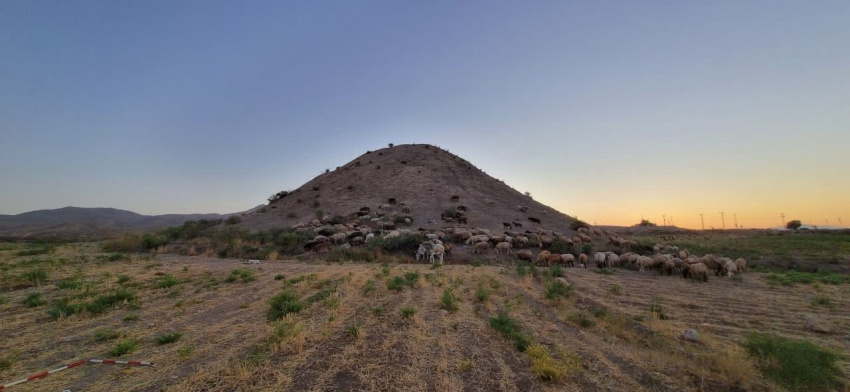
A field study program is being conducted to determine the area and propose the boundaries of “Aq Tepe” located in Pish Qala’eh city, the center of Maneh county in North Khorasan province, with the financial support of the General Department of Cultural Heritage, Tourism and Handicrafts of North Khorasan province, the support of the Maneh county governor, and with the permission of the National Cultural Heritage and Tourism Research Institute, and the approval and coordination of the Archaeological Research Institute. This program is being conducted under the supervision of Reza Naseri, a faculty member of the Department of Archaeology, Faculty of Arts and Architecture, University of Zabol, and as an external project.
“Aq Tepe” is one of the most important ancient settlements on the banks of the Atrak River, which dates back to the historical and early Islamic periods. This site consists of a tall, conical hill with a height of more than 15 meters and a wide, lower area adjacent to its western part, which covers a total area of more than 10 hectares. This area is connected to the lands of Pish-Qala'a city from the north and northeast and to the natural hills of the Duchang mountain range from the eastern Alborz range from the south.
The construction of the Raz and Jarglan county road and the Pish-Qala'a city entrance boulevard in the early Islamic Revolution has exposed some of the ancient layers of Aq-Tepe to destruction. Also, the establishment of some urban facilities, including a water reservoir and a meteorological station in the late 1990s, led to the accidental discovery of valuable artifacts such as more than 700 Arab-Sassanian and early Islamic period silver coins, which are currently kept in the Bojnourd Archaeological Museum.
Earlier, in the mid-1980s, archaeological studies including geophysical surveys and limited excavations were conducted along the Pish-Qala'a entrance boulevard, the results of which revealed architectural remains and numerous archaeological evidence, demonstrating the special importance of Aq-Tepe in regional research.
This external project is an important step for the University of Zabol in fulfilling its national and regional role in protecting cultural heritage and effectively interacting with related organizations. In the framework of this field program, by creating at least 35 test boreholes, the extent and extent of the archaeological remains of Aq Tepe will be determined and the basis for developing a future conservation plan and research strategy will be provided.
In addition to determining the area and privacy and developing conservation criteria, cultural materials from past discoveries will be reviewed and documented using modern methods. These measures will be the foundation of a sustainable urban development roadmap in the center of Mane County so that both historical interests and urban development needs are taken into account in future decision-making. It is worth noting that the Aq Tepe archaeological site was registered in the country's national monument list in 1977 with number 1420.
Your Comment :